
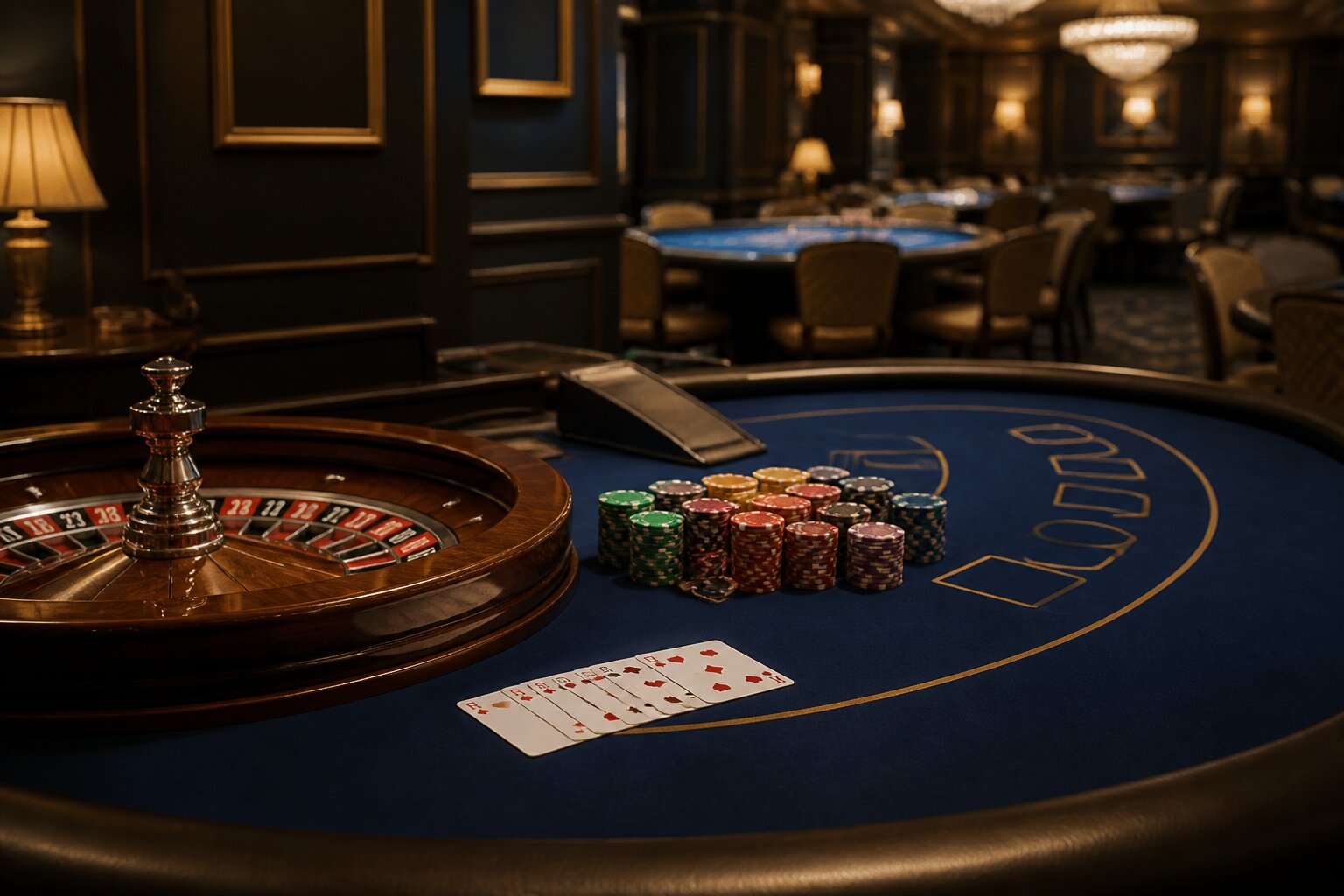
Ever felt the excitement of sitting at a casino table, chips stacked and heart thumping, wondering if there’s a way to play smarter? You’re definitely not alone. Many people ask which games truly offer better chances of finishing a session ahead, and understanding the underlying numbers can change how you approach the tables.
The key is the house edge — the mathematical advantage the casino has over players, expressed as a percentage of each bet. Different games and different bets within a game carry different edges, so some options are statistically kinder to players than others. With that in mind, the following sections look at how the most common table games compare and what that means for your play.
Understanding House Edge in Table Games
The house edge is the percentage of every wager that, on average and over a long period, the casino expects to keep. It doesn’t predict any single hand or spin; instead, it describes long-term expectation. For instance, a game with a 1% house edge suggests that, on average over many bets, the casino will retain £1 for every £100 wagered.
Blackjack illustrates how strategy can influence that edge: when played with basic strategy, its house edge can drop to around 0.5%. Single-zero (European) roulette typically sits near 2.7%, while many baccarat bets fall close to 1% on the banker option. Those figures show why game choice and bet selection matter.
Next we’ll look at which specific table games tend to offer the most favourable percentages and why those differences arise.
Which Casino Table Games Have the Favourable Odds?
Some table games consistently present lower house edges and therefore better statistical prospects for players who want the most even match-up. Blackjack often tops the list because skilled decision-making can reduce the house edge significantly. Baccarat, especially when backing the banker, is another option with a relatively low edge. Craps can be player-friendly too if players stick to the simpler bets like Pass Line or Don’t Pass.
Roulette’s appeal depends on the wheel: single-zero versions offer a smaller edge than double-zero ones, so choosing the right wheel matters. While these games can be more favourable in percentage terms, remember that the house edge is a long-run average and does not guarantee results in a short session.
To see how those percentages translate into real bets and payouts, the next section compares the main games side by side.
Comparing Popular Table Games: Odds & Payouts
Not all table-game bets are created equal. The house edge and the payout structure vary both between games and within a single game, depending on the exact wager chosen. Below are the key details for the major table-game categories to help you weigh risk versus reward.
Blackjack Odds Explained
Blackjack rewards informed choices. By following basic strategy for decisions such as hitting, standing, splitting or doubling down, the house edge can approach 0.5%. A standard even-money win returns 1:1, so a £10 stake wins £10; a natural blackjack commonly pays 3:2, meaning a £10 stake would win £15 on that hand in many games. These payout rules, combined with sensible strategy, explain blackjack’s favourable statistical position.
Roulette Odds: Inside vs Outside Bets
Roulette offers a spectrum of bets with very different return profiles. Straight-up bets on a single number pay 35:1 but have a small chance of success; even-money bets such as red/black and odd/even pay 1:1 and come in far more often. Single-zero (European) wheels reduce the house edge compared with double-zero variants, so choosing the right wheel and the right type of bet are both key to managing the odds.
Baccarat Game Odds
Baccarat focuses on two principal wagers: banker and player. Banker bets typically have the lowest house edge, which is why a commission on banker wins is common; player bets pay even money but carry a slightly higher edge. The rules for when a third card is drawn determine the modest difference in win frequency between the two hands, explaining why the banker option usually performs better over many rounds.
Craps Bets and Probabilities
Craps can look complex because of its many side bets, but the simplest options are among the most sensible for managing house advantage. Pass Line and Don’t Pass bets generally sit around a 1.4% edge, offering straightforward 1:1 payouts. Other propositions such as Any 7 carry much worse percentages and so require careful consideration before staking money on them.
With these comparisons in mind, the next section explores how player skill interacts with these odds and where it truly makes a difference.
Do Skill-Based Games Really Improve Your Chances?
Some table games let player decisions reduce the effective house edge; others offer no meaningful strategic influence. Blackjack is the main example where learned strategy materially improves long-term expectation. Players who use correct strategy for each situation are the ones who see the smallest average losses per wager.
Poker, as played against other players rather than the house, is even more skill-dependent: expertise in hand selection, betting patterns and reading opponents can yield a genuine competitive advantage. Conversely, games where outcomes are governed by mechanical processes — the precise dealing rules in baccarat or the spin of a roulette wheel — do not allow decisions to change the underlying probabilities.
Skill therefore matters in specific contexts but never eliminates the house edge when you are wagering against the casino. The final section looks at common misunderstandings about odds so those features don’t mislead your choices.
Common Myths About Table Game Odds
Widespread myths can distort how players approach table games. One frequent error is the belief that past results make a particular outcome more or less likely on the next event; each deal, roll or spin is an independent random event with its own unchanged probabilities. Another misconception is that all games or all bets have similar house edges — in reality, edges vary widely and depend on both the game and the precise wager.
Many people also assume betting systems can overcome the house edge. Systems may change the size and timing of wins and losses in the short term, but they do not alter the underlying mathematics that gives the house its edge over time.
Set clear limits and play within your means; treat casino play as entertainment rather than a way to make money. If you want to explore particular bets or need a quick reference for which options have lower edges, this guide should help steer you towards the choices that suit your priorities.
Enjoy Casino Games at Lion Wins
We’d love to welcome you to our site, where you can discover the fun of playing casino games with us in a safe and friendly environment. Join us and see why so many players enjoy spending time at Lion Wins.
Getting started is simple: just create an account, make your first deposit and you’re ready to play. We look forward to having you with us and hope you enjoy all the excitement we have to offer.
**The information provided in this blog is intended for educational purposes and should not be construed as betting advice or a guarantee of success. Always gamble responsibly.