
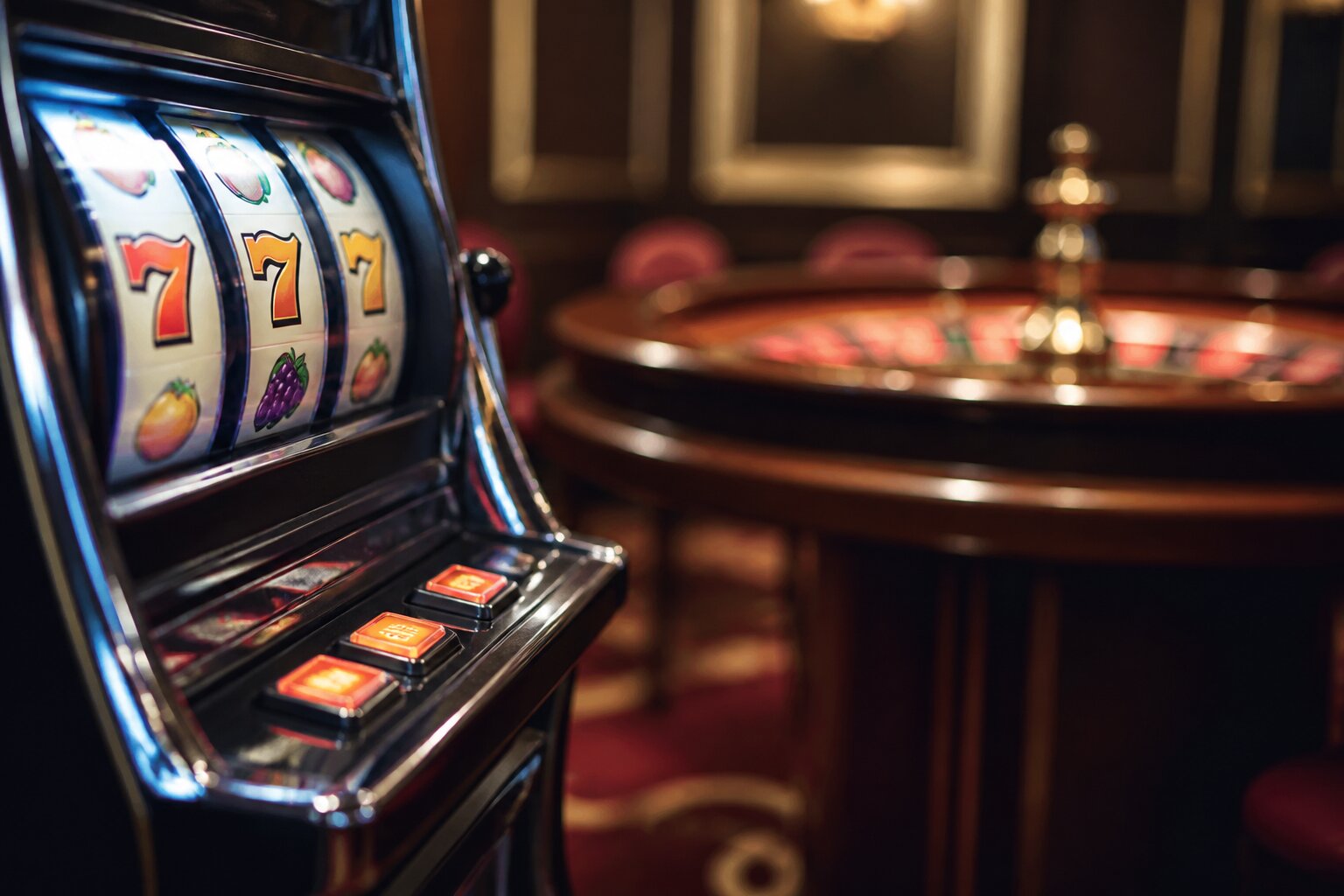
If you’ve ever stepped into a casino, you’ll notice slot machines and roulette tables drawing in crowds in very different ways. Both offer the pull of potential payouts and the buzz of play, but they deliver that experience through contrasting mechanics and atmospheres.
Maybe you like a quick, solitary spin that requires no thought, or perhaps you prefer a table game that invites bets and conversation. This article compares the two so you can decide which suits your style.
Understanding the Basics of Slot Machines and Roulette
Slot machines present rows of reels populated with symbols. Players stake an amount, spin the reels and await the result shown on the paylines. Modern machines use a random number generator (RNG) to determine outcomes and often add features such as wild and scatter symbols or bonus rounds to vary how wins are formed.
Roulette centres on a spinning wheel, a small ball and a marked betting layout. Players place chips on numbers, colours, or specific groups on the table; after the wheel is spun and the ball comes to rest, winning bets are paid according to the chosen type of wager. Two widely encountered formats are European roulette, which includes a single zero, and American roulette, which adds a double zero and alters the odds slightly.
Understanding these core mechanics makes it easier to compare how each game feels and what it demands from the player. Next we’ll look in more detail at how each one actually works at the table or on the floor.
How Does Each Game Work?
Both games welcome beginners, but the actions you take and the options available differ noticeably.
Slot Machine Fundamentals
Playing a slot begins with choosing a stake and activating the spin. Symbols land across reels on predetermined paylines; matching combinations trigger payouts as defined by the game’s paytable. The RNG assigns outcomes independently for every spin, so the displayed paylines and special features are simply ways the game structures potential returns and entertainment. RTP—return to player—is an important specification that indicates the theoretical long-term percentage a slot returns to players, and variance describes whether wins tend to be frequent and small or rare and large.
Roulette Table Explained
Roulette play involves placing chips on a layout to predict where the ball will settle on the wheel. Bets vary from single numbers, which pay at higher odds, to broader wagers such as colours or ranges that pay less but cover more possibilities. After the bets are set, the dealer spins the wheel and releases the ball; when it stops in a numbered pocket, corresponding bets are settled. The existence of single or double zero pockets affects the mathematical edge the house retains, which in turn influences the odds available to players.
With the mechanics established, the next section compares how these formats shape the atmosphere and the social side of play.
Comparing the Appeal: Atmosphere and Experience
Slot machines create a largely solitary experience. A player sits at a machine, chooses stakes, and progresses at personal pace with the game providing visual and audio feedback. This environment suits those who prefer fewer interruptions and a focused, self-contained session.
Roulette delivers a communal feel. Several players can bet on the same spin, and the dealer’s announcements set a tempo that the table follows. That shared anticipation as the wheel slows is an intrinsic part of the experience, and the range of bet types gives players different ways to engage with the group dynamic.
Both environments have distinct appeals: slots for private, uninterrupted play and roulette for social interaction and variety in betting. In the next section we’ll examine what those differences mean for odds and payouts.
What Are the Odds and Payouts?
Knowing the odds and how payouts are structured helps set realistic expectations.
Slot Machine Odds and Variance
A slot’s RTP is the primary figure to consider: it represents the proportion of stakes a game is designed to return to players over a very large number of spins. Common RTP values fall roughly between 92% and 97%, though this varies by title. RTP is a theoretical long-run average calculated from the game maths and does not guarantee any particular outcome in a single session.
Variance explains the rhythm of wins. High variance slots tend to deliver larger payouts but much less frequently, which can lead to longer losing runs before a big win occurs. Low variance slots offer smaller, more regular wins, giving a steadier experience but with fewer chances of very large prizes. Both RTP and variance are properties of the game design and remain constant from one session to the next, subject to the random number generator that ensures each spin is independent.
It is also worth noting that slot outcomes are driven by a random number generator, which means every spin is independent and cannot be predicted from previous spins. Players should treat RTP and variance as guides for what to expect over time rather than guarantees for any short play period.
Roulette Odds for Different Bets
Roulette presents a menu of bet types that trade risk and reward. A single-number bet pays 35 to 1 but carries a low probability of success, while even-money bets such as red/black pay 1 to 1 and cover about half of the non-zero numbers. The presence of zero pockets reduces the true probability of winning those even-money bets below 50%, which is why the house retains an edge.
The choice between European and American wheels affects those probabilities directly, due to the differing number of zero pockets. A European wheel has a single zero and gives a house edge of about 2.7% on most bets. An American wheel adds a double zero and increases the house edge to about 5.26%, making the odds noticeably worse for the player over the long run.
As with slots, roulette outcomes are determined by chance on each spin, so short-term results can vary widely from theoretical expectations. Understanding the payout structure and the house edge can help players make more informed decisions about which bets match their risk tolerance. Having clarified how payouts are framed, the next section considers the underlying house advantage each game offers.
House Edge: Which Game Is Fairer?
The house edge is the statistical advantage the operator holds over players, expressed as a long-term percentage of stakes.
European roulette’s single zero produces a house edge of about 2.7%. The American wheel’s extra double zero raises that edge to roughly 5.26%. Slot machines do not share a single universal figure; their house edge is tied to the game’s RTP and typically falls somewhere in a range that can translate to roughly 3% to 8%, depending on the title. These percentages are theoretical averages calculated over many plays, reinforcing that short sessions can still produce a wide range of results for an individual player.
Understanding the house edge helps when choosing between games, and it also connects to how much involvement you want in shaping your play—whether that be simple button presses or a selection from multiple bet types.
Skill vs Simplicity: Who Are These Games Best For?
Slot play requires very little decision-making beyond stake level and, occasionally, payline choices. That simplicity makes slots accessible and straightforward: the entertainment comes from the game’s theme, features and the rhythm of spins.
Roulette demands more active decisions about which bets to place and in what combination. Although those choices change exposure and potential payouts, there is no skill that can influence the physical outcome of the spin; instead, strategy refers to managing stakes and bet selection in pursuit of a preferred risk profile.
Players seeking uncomplicated, low-maintenance play often prefer slots, while those who enjoy choosing from a variety of bets and being part of a table tend to favour roulette. Next, we’ll address a few common misconceptions that can affect how people approach both games.
Popular Myths About Slot Machines and Roulette
One frequent misunderstanding is that a slot can be “due” to pay out after a series of losses. In reality, each spin is independent and governed by the RNG, so previous spins have no causal effect on future outcomes. Similarly, the idea that a roulette wheel will balance out recent results—such as expecting red after several blacks—is a mistaken reasoning pattern known as the gambler’s fallacy; every spin is statistically separate.
Both electronic and live games in regulated environments are subject to testing and oversight to ensure fairness and proper operation. Relying on systems or timing theories does not alter the underlying mathematics that determine payouts and probabilities.
Clearing up these myths helps keep expectations grounded, and the following section outlines practical ways to maintain control while playing.
Playing Responsibly: Tips for a Fun Casino Experience
Enjoyment is best preserved when play is bounded by clear limits. Decide in advance how much money and time you are comfortable spending, and stick to those limits so play remains a leisure activity rather than a source of stress. Avoid chasing losses; outcomes remain random regardless of past results, and changing your stake in response to losses does not increase the chance of recovery.
If gambling stops being enjoyable or control becomes a concern, confidential support is available in the UK through organisations such as BeGambleAware and GamCare. These services offer practical guidance and tools to help manage play safely. Keeping play within agreed boundaries protects wellbeing and preserves the entertainment value of the experience.
Which Game Should You Choose? Key Factors to Consider
Deciding between slots and roulette comes down to personal preference. If you favour a quiet, solitary session with little decision-making and a variety of visual or thematic content, slots match that mood. If you prefer to be part of a shared table, enjoy selecting from a range of bet types and like the rhythm of communal play, roulette will likely suit you better.
Consider also how much control and variety you want in betting, your tolerance for variance in results, and the kind of atmosphere that enhances your enjoyment. Choose the game that aligns with those factors, stick to self-imposed limits and treat play as entertainment. That approach will help ensure your time at the casino stays enjoyable and within your comfort zone.
**The information provided in this blog is intended for educational purposes and should not be construed as betting advice or a guarantee of success. Always gamble responsibly.