
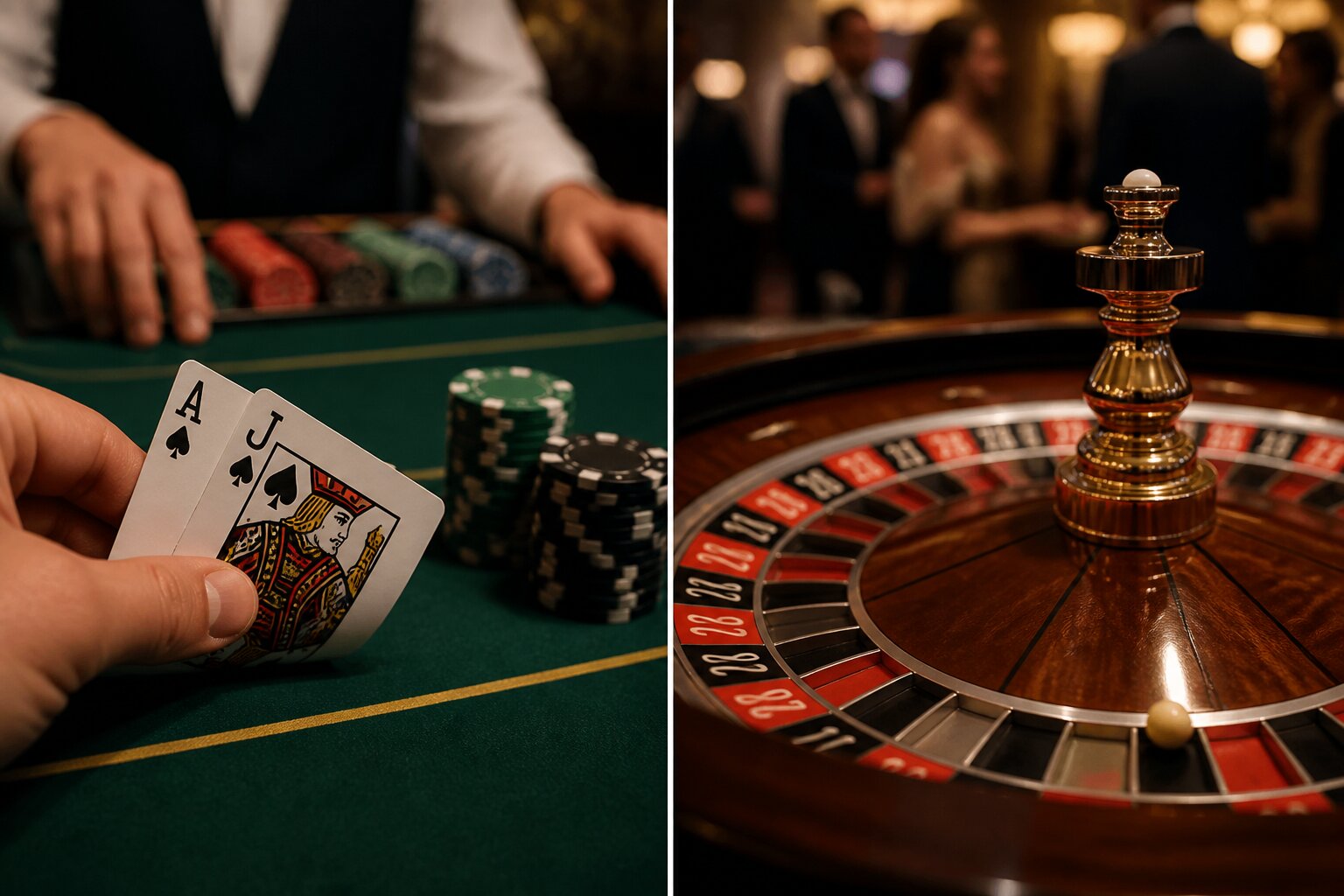
Trying to decide whether to play blackjack or roulette? Both are classic casino games with different styles, strategies and ways to win. Knowing how odds, payouts and house edge work will help you choose which suits your approach and how long your bankroll might last.
Before you place your chips, understanding these differences lets you pick a game that fits your preferences — whether you want to influence outcomes with decisions or prefer betting on fixed probabilities. Read on to see how the two games compare in practice and what to bear in mind at the table.
Curious which gives better value for your play? The sections that follow break down rules, odds, payouts and common misconceptions so you can decide with confidence.
What Are the Main Differences Between Blackjack and Roulette?
Blackjack and roulette offer contrasting experiences. Blackjack is a card game where you play against the dealer, aiming for a total closer to 21 than the dealer without exceeding it. You receive cards and then make choices — for example whether to take another card or keep your total — so decisions you make influence each round’s course.
Roulette revolves around a spinning wheel and a ball that lands in a numbered pocket. Players place bets on numbers, colours or groups of numbers; once the wheel is spun no further choices affect that outcome. In roulette you’re selecting from a set of fixed bets with known probabilities.
Table layout and pace also differ. Blackjack tables seat fewer players and deal hands directly to each spot, creating a more decision-driven rhythm. Roulette tables centre on the wheel and a large betting layout, letting many players place a range of bets each spin. These structural differences shape how a session feels and how much player input matters.
If you prefer making ongoing decisions and adapting to the cards, blackjack tends to be more engaging. If you favour a variety of betting options and a predictably paced round-to-round experience, roulette may be the better fit.
How Do the Rules of Blackjack and Roulette Affect Your Game?
Specific rules change the choices you can make and the mathematical odds behind each game.
In blackjack, factors such as the number of decks in use, whether the dealer hits or stands on a soft 17, and whether doubling down or splitting is permitted all influence the strategic options available. For example, fewer decks generally improve the player’s position slightly because card composition becomes easier to gauge. Allowing double down after splitting or permitting late surrender can also reduce the casino’s advantage.
Roulette’s rule differences are simpler but significant. The key distinction is wheel type: a single-zero wheel (commonly called European) offers a lower house advantage than a double-zero wheel (American). Some roulette tables apply special rules like la partage or en prison, which return or hold part of even-money bets when the ball lands on zero, lowering the effective house edge on those bets.
Because rules directly change the expected returns and how you would approach a session, always check the specific table rules before you play. Knowing the exact conditions helps you plan your play and choose which bets or strategies are sensible for that game.
If you want to compare how those rules feed into odds and payouts, the next section breaks down probability and typical chances of winning.
Understanding Odds: Which Game Offers Better Chances of Winning?
Odds describe the probability of a particular outcome occurring, and they vary between games and bet types.
In blackjack, the chance of winning a single hand typically falls in the 42–49% range, influenced by table rules and how you play. Using basic strategy — a mathematically derived set of decisions for each hand versus the dealer’s upcard — brings your win rate closer to the favourable end of that spectrum and reduces the house edge, but it does not guarantee a positive session.
Roulette odds depend entirely on the bet you choose. On a European wheel (single zero), a straight-up bet on a single-number roulette bets has a chance of 1 in 37 (about 2.7%); an even-money bet such as red or black has a slightly lower than 50% chance because of the zero. On an American double-zero wheel, those probabilities change because there are more non-winning pockets, reducing the success rate of each bet.
Understanding these probabilities helps you match bet choices to your objectives: if you want higher frequency of wins, even-money bets in roulette or conservative blackjack play are more suitable; if you prefer the possibility of larger payouts, single-number roulette bets or aggressive blackjack plays yield less frequent but larger returns.
House Edge Explained: How Does It Differ in Both Games?
House edge is the long-run percentage the casino expects to retain from all bets. It’s the primary measure of how favourable a game is for the player over extended play.
Blackjack can offer one of the lowest house edges when played with optimal basic strategy and favourable rules, often around 0.5% under good conditions. Less favourable rules — multiple decks, dealer hitting soft 17, or restricted doubling options — can push that edge closer to 2% or more. This variability means that rule details matter a great deal for blackjack.
Roulette’s house edge is determined mainly by the wheel design. European roulette’s single zero produces a house edge of 2.7% across most bets. American roulette, with both a single and double zero, has an edge of 5.26%. Special rules such as la partage can reduce the effective edge on even-money bets, but those rules are not always available.
Because the house edge is a long-term average, short sessions can deviate widely from these figures. Knowing the house edge helps you set realistic expectations about how your session will perform over time and choose the game that matches your tolerance for variance.
Now that we’ve covered odds and edge, let’s look at how those translate into the money you might receive when a bet succeeds.
Comparing Payouts: What Can You Expect from Each Game?
Payouts are fixed and tied to the type of bet you make; they determine how much you receive when a bet wins, relative to your stake. Knowing the payout structure is essential because it directly affects the value of a winning wager and the game’s effective house edge.
Standard Payouts in Blackjack
A standard winning blackjack hand normally pays 1:1, returning your stake plus an equal amount in winnings. Achieving a blackjack on the first two cards — an ace with a ten-value card — usually pays 3:2, so a £10 blackjack returns £25 in total (your stake plus £15 winnings) at tables offering this rate.
Some venues offer altered blackjack payouts, which can materially change the value of a blackjack and increase the house advantage. Common payout examples include:
- 3:2, the traditional and more favourable payout for players.
- 6:5, a less favourable payout that reduces the return for a winning blackjack.
Always check the payout structure before you play, because even small differences in payout ratios can have a noticeable effect on long-term results.
Common Payouts in Roulette
Roulette payouts vary by bet type and typically reflect the probability of that outcome. A straight-up bet on a single number pays 35:1, so a £1 stake yields £36 in total when successful.
Other bet types pay smaller amounts but offer higher chances of winning. Examples include:
- Split bets (two numbers).
- Street bets (three numbers).
- Column and dozen bets.
- Even-money bets such as red/black or odd/even, which pay 1:1.
The trade-off is always between payout size and probability: smaller payouts come with higher chances of winning, while larger payouts are rarer.
Understanding payout structures alongside odds and house edge lets you evaluate whether a particular bet matches your risk and reward preferences. Make sure you are familiar with table rules and payout rates before staking real money.
Are There Common Myths About Blackjack and Roulette Odds?
Several widespread misconceptions can mislead players about how these games operate.
One persistent idea is that past results in roulette affect future spins. Each spin is independent, so prior outcomes do not change the probability of a future result. In blackjack, another misconception is that betting systems or specific patterns will overcome the house edge; while some approaches manage variance or bankroll better, they do not alter the underlying mathematics.
Basic strategy in blackjack reduces the house edge by prescribing optimal decisions for each situation, but it does not eliminate the house advantage. Similarly, taking consolation rules such as la partage can improve roulette outcomes for even-money bets but do not turn the game in the player’s favour.
If you’re unsure about a claim you hear, refer back to the earlier explanations of probability, payouts and house edge to test whether it stands up. Critical thinking and a clear grasp of the rules are the best defence against misleading myths.
Which Game Appeals More to British Casino Players?
Player preferences shape which game feels more rewarding.
Blackjack attracts those who enjoy calculated decisions and an interactive pace; each hand gives you options and the sense that your choices change outcomes within the bounds of the rules. Roulette tends to appeal to players who like a simpler decision process and a broader range of bet types, from conservative even-money wagers to high-payout single-number bets.
The social atmosphere differs, too: blackjack tables often encourage conversation and shared decision-making, while roulette tables can feel more communal during spins but less focused on individual tactics. Both games remain popular in UK venues because they offer distinct experiences, and many players switch between them depending on mood or session goals.
Whether you prefer the decision-driven play of blackjack or the variety of roulette bets, the best choice aligns with how you enjoy spending your time and money.
Choosing Between Blackjack and Roulette: What Should You Consider?
When choosing a game, think about how the rules, odds and payouts we've described fit your priorities.
If you want more influence over outcomes and the potential for a lower house edge with informed play, blackjack with favourable rules is likely the better match. If you prefer a straightforward betting framework with many ways to vary stake size and payout potential, roulette gives a wide menu of options.
Also consider session length and bankroll management: blackjack’s decision-driven rounds can sustain longer sessions when played conservatively, while roulette’s range of bets lets you control volatility by selecting larger numbers of smaller-probability bets or steadier even-money wagers.
Finally, set clear monetary limits before you begin and use available tools at regulated venues to keep play within those limits. Choose the game that delivers the most enjoyment within your budget, and let that guide your decision.
Whichever you pick, understanding the differences in rules, odds, payouts and house edge will help you make sensible choices and get the most from your time at the table.
**The information provided in this blog is intended for educational purposes and should not be construed as betting advice or a guarantee of success. Always gamble responsibly.